

Hey there! As a supplier of PSA Nitrogen Generators, I often get asked about the energy consumption of these nifty machines. So, let's dive right in and break it down.
First off, what's a PSA Nitrogen Generator? Well, PSA stands for Pressure Swing Adsorption. It's a technology that separates nitrogen from other gases in the air. The PSA Nitrogen Generator uses two towers filled with a special adsorbent material, usually carbon molecular sieve (CMS). When compressed air flows through one tower, the CMS adsorbs oxygen, water vapor, and other impurities, allowing nitrogen to pass through and be collected. Meanwhile, the other tower is being regenerated by reducing the pressure, which releases the adsorbed gases. This process alternates between the two towers, providing a continuous supply of nitrogen.
Now, let's talk about energy consumption. The energy requirements of a PSA Nitrogen Generator mainly come from two sources: the air compressor and the control system.

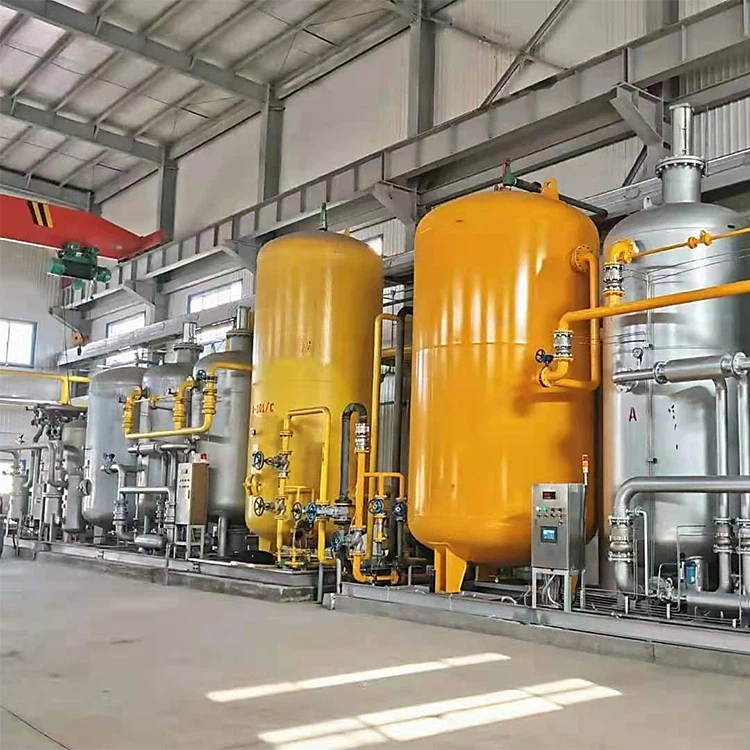
The air compressor is the biggest energy hog. It's responsible for compressing the incoming air to the required pressure for the PSA process. The power consumption of the compressor depends on several factors, such as the flow rate of nitrogen you need, the purity of the nitrogen, and the operating pressure.
For example, if you need a high flow rate of nitrogen with a high purity level, the compressor will have to work harder and consume more energy. On the other hand, if you can tolerate a lower purity level or a lower flow rate, the compressor won't have to work as hard, and you'll save on energy costs.
Let's say you have a small - scale operation that only needs a low flow rate of nitrogen, like 1 - 5 cubic meters per hour (m³/h) with a purity of 95%. In this case, a relatively small air compressor can do the job, and the energy consumption will be quite low. You might be looking at a compressor with a power rating of around 1 - 3 kilowatts (kW).
But if you're running a large industrial plant that requires a high flow rate of nitrogen, say 50 - 100 m³/h with a purity of 99.9%, the compressor will be much larger and more powerful. It could have a power rating of 30 - 50 kW or even more.
The control system of the PSA Nitrogen Generator also consumes some energy, but it's a relatively small amount compared to the compressor. The control system is responsible for regulating the pressure, flow rate, and timing of the PSA process. It typically consists of valves, sensors, and a programmable logic controller (PLC). The power consumption of the control system is usually in the range of a few hundred watts.
Another factor that affects energy consumption is the efficiency of the PSA process itself. A well - designed PSA Nitrogen Generator will have a high adsorption efficiency, which means it can produce more nitrogen with less energy. This is where the quality of the adsorbent material and the design of the towers come into play.
Some advanced PSA Nitrogen Generators use features like variable frequency drives (VFDs) on the air compressor. A VFD allows the compressor to adjust its speed based on the actual demand for nitrogen. So, if the demand decreases, the compressor can slow down and consume less energy. This can result in significant energy savings over time.
Let's compare the energy consumption of a PSA Nitrogen Generator with other methods of nitrogen production. One alternative is to use liquid nitrogen. Liquid nitrogen is produced by cryogenic distillation, which is a very energy - intensive process. The energy required to produce liquid nitrogen is much higher than that of a PSA Nitrogen Generator. Plus, you need to consider the energy for storage and transportation of the liquid nitrogen.
Another alternative is a membrane nitrogen generator. Membrane nitrogen generators work by separating nitrogen from air based on the different permeation rates of gases through a membrane. While membrane nitrogen generators are generally more energy - efficient for low - purity applications, they struggle to achieve high purity levels. For high - purity nitrogen requirements, a PSA Nitrogen Generator is often a better choice, even though it may consume more energy than a membrane generator at low purities.
Now, if you're in the market for a PSA Nitrogen Generator, it's important to consider the long - term energy costs. When evaluating different models, look at the energy consumption data provided by the manufacturer. Ask about the specific power requirements of the compressor and the control system. Also, inquire about any energy - saving features, such as VFDs or advanced control algorithms.
As a supplier, we understand that energy efficiency is a top concern for our customers. That's why we offer a range of PSA Nitrogen Generators with different capacities and energy - saving features. We can work with you to determine the most suitable model for your specific needs, taking into account your nitrogen flow rate, purity requirements, and budget.
If you're also interested in oxygen generation, we also have VPSA Oxygen Generator. VPSA stands for Vacuum Pressure Swing Adsorption, and it's a similar technology used for oxygen production. The energy consumption of a VPSA Oxygen Generator also depends on factors like the flow rate and purity of oxygen, but that's a topic for another blog post.
In conclusion, the energy consumption of a PSA Nitrogen Generator is mainly determined by the air compressor, with the control system contributing a smaller amount. By choosing the right model with the appropriate capacity and energy - saving features, you can optimize your energy costs while getting the nitrogen you need for your operations.
If you're thinking about purchasing a PSA Nitrogen Generator or have any questions about energy consumption, feel free to reach out to us. We're here to help you make an informed decision and find the best solution for your business.
References
- "Pressure Swing Adsorption" by Douglas M. Ruthven, S. Farooq, and K. S. Knaebel
- "Gas Separation by Adsorption Processes" by Ralph T. Yang