

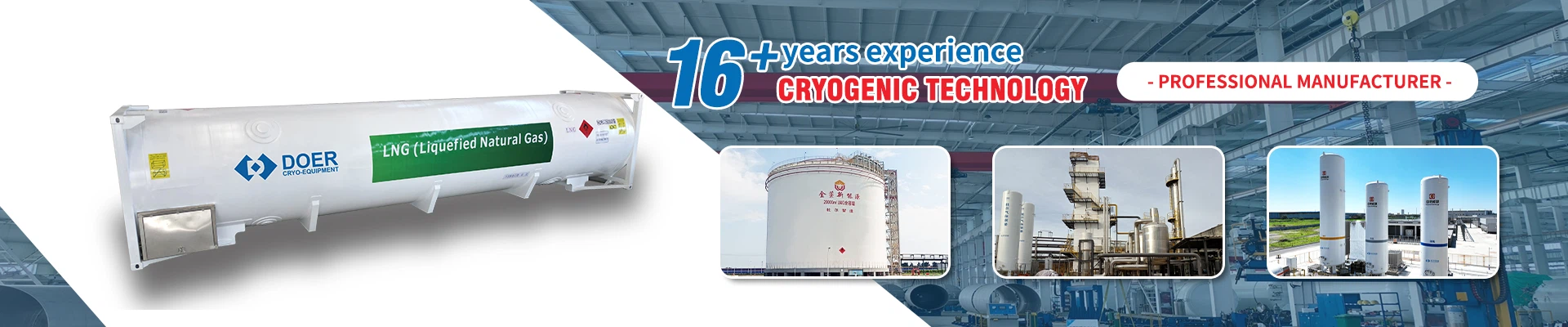
Cryogenic Storage Tank
Your Professional Cryogenic Storage Tank Supplier
Suzhou Doer Gas &Chemical Equipment Co., Ltd. Was established in 2009 and is located in Xiangcheng District, Suzhou. It is a high-tech enterprise integrating R&D, design, manufacture, complete engineering, industrial services, and investment operations. The company has a registered capital of 100 million yuan, has 6 subsidiaries, two production bases with a total area of about 135,000 square meters, and a total number more than 400 employees.
Our Product
Large Scale Atmospheric Cryogenic Storage Tank, Vacuum Cryogenic Liquid Storage, Cryogenic Liquid Transportation Equipment, LNG Marine Equipment, Turn-key project.
Production Market
Suzhou Doer Gas & Chemical Equipment Co., Ltd. is a comprehensive solution provider and service provider that integrates low-temperature technology research and development, design, equipment manufacturing, engineering general contracting, industrial services, and investment and operation.
Production Equipment
Electric single beam crane, bridge crane, Laser cutting machine, Inverter DC arc welding machine.
-
![LNG Flat Bottom Storage Tank]() LNG Flat Bottom Storage TankFunction: Storage Cryogenic liquidread more
LNG Flat Bottom Storage TankFunction: Storage Cryogenic liquidread more
Type: Double layer metal wall
Storage Medium: Liquid Natural Gas -
![Ammonia Flat Bottom Storage Tank]() Ammonia Flat Bottom Storage TankFunction: Storage Cryogenic liquidread more
Ammonia Flat Bottom Storage TankFunction: Storage Cryogenic liquidread more
Type: Double layer metal wall
Storage Medium: Liquid ammonia -
![LOX Flat Bottom Storage Tank]() LOX Flat Bottom Storage TankFunction: Storage Cryogenic liquidread more
LOX Flat Bottom Storage TankFunction: Storage Cryogenic liquidread more
Type: Double layer metal wall
Storage Medium: Liquid Oxygen -
![LIN Flat Bottom Storage Tank]() LIN Flat Bottom Storage TankFunction: Storage Cryogenic liquidread more
LIN Flat Bottom Storage TankFunction: Storage Cryogenic liquidread more
Type: Double layer metal wall
Storage Medium: Liquid nitrogen -
![LAR Flat Bottom Storage Tank]() LAR Flat Bottom Storage TankFunction: Storage Cryogenic liquidread more
LAR Flat Bottom Storage TankFunction: Storage Cryogenic liquidread more
Type: Double layer metal wall
Storage Medium: Argon -
![Ethylene Cryogenic Flat Bottom Tank]() Ethylene Cryogenic Flat Bottom TankFunction: Storage Cryogenic liquidread more
Ethylene Cryogenic Flat Bottom TankFunction: Storage Cryogenic liquidread more
Type: Double layer metal wall
Storage Medium: LC2H4, Liquid Ethylene
Structure: Full containment -
![Propane Flat Bottom Storage Tank]() Propane Flat Bottom Storage TankFunction: Storage Cryogenic liquidread more
Propane Flat Bottom Storage TankFunction: Storage Cryogenic liquidread more
Type: Double layer metal wall
Storage Medium: Liquid Propane -
![Butane Flat Bottom Storage Tank]() Butane Flat Bottom Storage TankFunction: Storage Cryogenic liquidread more
Butane Flat Bottom Storage TankFunction: Storage Cryogenic liquidread more
Type: Double layer metal wall
Storage Medium: Liquid Butane -
![LNG Vacuum Storage Tank]() LNG Vacuum Storage TankFunction: Storage Cryogenic Liquidread more
LNG Vacuum Storage TankFunction: Storage Cryogenic Liquidread more
Type: Vertical or Horizontal
Storage Medium: LNG Liquid Natural Gas -
![Oxygen Vacuum Storage Tank]() Oxygen Vacuum Storage TankFunction: Storage Cryogenic Liquidread more
Oxygen Vacuum Storage TankFunction: Storage Cryogenic Liquidread more
Type: Vertical or Horizontal
Storage Medium: LOX/Liquid Oxygen -
![Nitrogen Vacuum Storage Tank]() Nitrogen Vacuum Storage TankFunction: Storage Cryogenic Liquidread more
Nitrogen Vacuum Storage TankFunction: Storage Cryogenic Liquidread more
Type: Vertical or Horizontal
Storage Medium: LIN/ Nitrogen -
![Argon Vacuum Storage Tank]() Argon Vacuum Storage TankFunction: Storage Cryogenic Liquidread more
Argon Vacuum Storage TankFunction: Storage Cryogenic Liquidread more
Type: Vertical or Horizontal
Storage Medium: LAr/ Argon


Cryogenic Storage Tank
Cryogenic storage refers to storing substances at extremely low temperatures, typically below -150°C (-238°F). These ultra-cold environments are essential for preserving the integrity of materials that would otherwise degrade or become unstable at higher temperatures. For instance, certain gases like nitrogen, oxygen, and hydrogen need to be stored in liquid form, which requires cryogenic conditions.
When we talk about cryogenic storage, we can’t overlook the role of the cryogenic storage tank. These tanks are specially designed containers that can hold cryogens (liquefied gases) and keep them at their required low temperatures without evaporating.
Product Parameters
|
Design code |
• JB/T13369 "Powder thermal-insulating low-pressure cryogenic liquid storage tanks" |
|
|
• API620-2018 "Design and construction of large ,welded, low-pressure storage tanks" |
||
|
• JB/T13369 |
||
|
• API620-2018 |
||
|
Type |
Double layer metal wall |
|
|
Insulation Type |
Perlite powder + cellular glass insulation block |
|
|
Design Temperature |
Inner Vessel |
-196/+50℃ |
|
Outer Shell |
-19/+50℃ |
|
|
Design pressure |
Inner Vessel |
25/-0.5kPa |
|
Outer Shell |
1.0/-0.5kPa |
|
|
Working Pressure |
5~20kPa or Customized pressure |
|
|
The Main Material |
Inner Vessel |
S30408 (National Standard) S30400,304(ASTM) |
|
Outer Shell |
Q235B/Q245R/Q345R (National Standard) SA516Gr.60/SA516Gr.70(ASME) |
|
|
Volume |
1000m³≤V≤100000m³ or Customized Size |
|
|
Mode of transportation |
Road, Sea or Railway |
|
|
Core Components |
Primary container, Secondary container, Insulation system, Pipeline, Ladder & platform, Valves & Instruments, electric system. |
|
|
Supply state |
Prefabricated material supply, on-site installation |
|
|
Painting |
Primer coat (Prefabricated)+ intermediate coat(on-site) + topcoat (on-site) |
|
|
Design service life |
20years |
|

With high safety and sealing, it can ensure the safety of storage and prevent accidents, widely used in petrochemical and other fields.
We design our cryogenic liquid flat-bottom storage tanks with double- wall steel structures using high tech insulating materials (perlite powder+ cellular glass insulation block).
Structure: Flat-bottomed, dome roof, vertical double-layer metal wall.
Core advantages of cryogenic storage tanks
High-efficiency insulation ·Low evaporation
·Vacuum multi-layer insulation technology (such as vacuum powder/winding) effectively blocks heat conduction and maintains long-term stability of media such as LNG (-162ºC).
·Daily evaporation rate ≤0.3%, extremely low medium loss, and controllable operating costs.
Multiple safety protections
·Anti-leakage design: Double-layer closed structure (liner + vacuum interlayer) + safety valve/bursting disc to eliminate overpressure and leakage risks.
·Strong weather resistance: Stainless steel/aluminum alloy material, low temperature resistance, corrosion resistance, in line with ASME/GB standards, and adaptable to complex environments.
Large capacity·low cost
·The capacity of a single tank is 150m³+, meeting the large-scale storage needs of industrial energy.
·The liquefied volume is reduced by 600 times, saving storage and transportation space, and reducing the overall cost by more than 40%.
Flexible adaptation ·Customization
·Multiple forms are available: Vertical/horizontal/mobile (tank truck), suitable for gas stations, chemical plants and other scenes.
·Non-standard customization: Support on-demand adjustment of size, pressure and interface to meet special working conditions.
How Does a Cryogenic Storage Tank Work
A cryogenic storage tank is not your average container. These tanks are vacuum insulated, which minimizes heat transfer and helps maintain the low temperatures required for storing cryogens. Here’s how it works:
Vacuum Insulation
The tank is essentially two layers of metal with a vacuum between them. The vacuum acts as an insulator, preventing heat from entering the tank and warming up the cryogens.
Durability
Cryogenic tanks are made from materials like stainless steel or aluminum, which can withstand the extreme cold and pressure.
Safety Features
Cryogenic tanks are equipped with pressure-relief valves and safety systems to ensure that they don’t become over-pressurized.
Tanks for storing cryogenic gases follow very strict safety requirements and protocols, in order to avoid any type of accident that may cause leaks, material damage and, above all, personal injury. Here are some of the main safety measures:
All cryogenic tanks are constructed with a double wall: An inner vessel and an outer vessel, which acts as an encasing. In addition, they are separated by an intermediate chamber that acts as a thermal insulating element, which ensures that the cryogenic fluids are always at the right temperature.
These tanks are equipped with relief valves and rupture or bursting discs, which automatically release the gas in the event of an unforeseen pressure increase. This ensures that the pressure is constantly maintained at the correct levels.
Not only is storage safe, so is transport, which is carried out in tankers that are also double-walled and vacuum insulated by means of an inter-chamber.

Design and Construction of Cryogenic Storage Tanks
Materials and Insulation
Cryogenic storage tanks are constructed using materials with exceptional thermal properties to withstand the extreme cold and maintain the low temperatures of their contents. Common materials include stainless steel, aluminum, and nickel alloys due to their resistance to embrittlement at low temperatures. To minimize heat transfer and preserve the stored substances’ frigid state, these tanks are equipped with high-efficiency insulation materials, such as perlite, aerogel, and vacuum-insulated panels.
Double-Walled vs. Single-Walled Tanks
Cryogenic storage tanks are often designed with either single-walled or double-walled configurations. Single-walled tanks are simpler in design and construction, but they may have limitations in terms of heat transfer prevention and safety in case of leaks. Double-walled tanks, on the other hand, offer an additional layer of protection by creating a vacuum space between the inner and outer walls, reducing heat transfer and minimizing the risk of cryogenic fluid release.
Safety Features and Considerations
Safety is of paramount importance when dealing with cryogenic fluids. Pressure relief systems are integral components, ensuring that pressure doesn’t build up excessively within the tank. These systems release excess pressure through controlled vents. Leak detection and prevention mechanisms are also essential to avoid hazardous situations. Advanced sensors are used to monitor any leaks, triggering alarms and shutdown procedures if necessary.
Types of Cryogenic Storage Tanks
Liquefied Natural Gas (LNG) has gained prominence as a cleaner alternative to traditional fossil fuels. LNG storage tanks are crucial for storing and transporting natural gas in its liquid state, reducing its volume and enabling efficient transportation. These tanks are designed to handle the extreme cold and low temperatures of LNG, often reaching below -160°C (-256°F). While LNG tanks are generally double-walled for safety, they require specialized materials and insulation due to the specific characteristics of natural gas.
Cryogenic storage isn’t limited to energy applications. Tanks designed for storing liquefied oxygen, nitrogen, and argon find extensive use in medical, industrial, and scientific fields. Oxygen, for instance, is stored cryogenically for medical procedures and respiratory therapies. These tanks face challenges in maintaining the low temperatures of their contents, as oxygen and nitrogen have boiling points as low as -183°C (-297°F) and -196°C (-321°F), respectively.
With the growing emphasis on renewable energy, hydrogen is gaining attention as a clean energy carrier. Cryogenic storage of hydrogen is essential to keep it in a compact state, as hydrogen’s volumetric energy density increases significantly when liquefied. These tanks are designed to endure the low temperatures and high pressures required for hydrogen storage, making use of advanced materials and safety measures.
Choosing the Right Cryogenic Tank for Your Needs
The choice between manual and autofill cryogenic tanks ultimately depends on the specific requirements of your application and your budget. Here are some key considerations to guide your decision:
Usage Frequency
If you require a constant and uninterrupted supply of cryogenic fluids, an autofill tank is likely the better choice. For infrequent use or smaller operations, a manual tank may work well.
Budget Constraints
Evaluate your budget. While manual tanks are more cost-effective upfront, consider the long-term operational costs and benefits of an autofill tank’s convenience and reliability.
Technical Expertise
Consider the availability of personnel with the expertise to handle manual refilling or the maintenance of autofill systems.
Certificate

FAQ
We're well-known as one of the leading cryogenic storage tank manufacturers in China. If you're going to wholesale high quality cryogenic storage tank made in China, welcome to get quotation from our factory.