

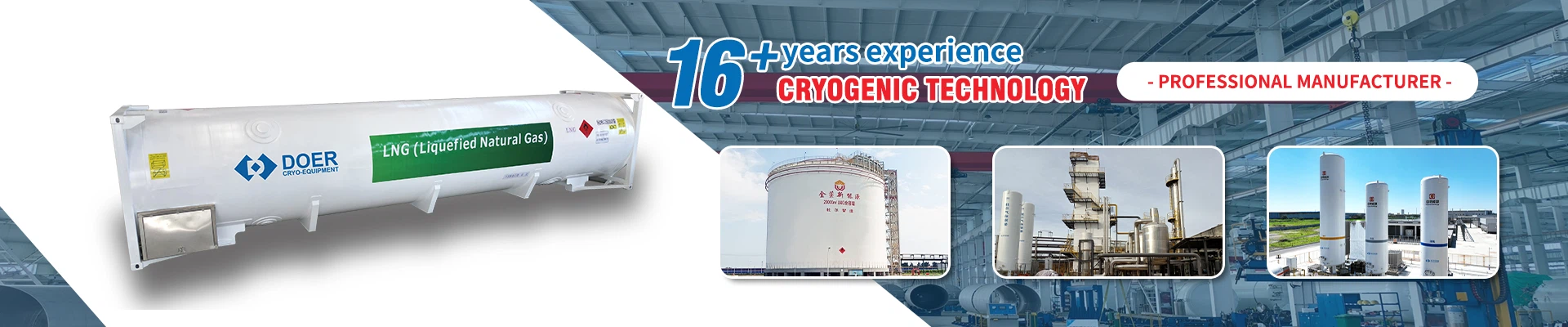
The working principle of cryogenic storage tanks is mainly to maintain the low temperature of the stored liquid by using insulating materials and thermal insulation layers to reduce heat conduction, convection and radiation through the design of a double-layer structure. Cryogenic storage tanks usually adopt a double-wall structure, with a storage tank inside and an insulating layer and a protective layer outside. Insulating materials such as polyurethane foam, thermal insulation layers such as steel plates, aluminum foil, and vacuum pumping, etc. This design ensures the stability and safety of the stored liquid.
The operating temperature of cryogenic storage tanks is generally around -140℃, and the design pressure is generally around 1Mpa. The inner tank is made of low-temperature resistant alloy steel, and the outer shell is to form the insulation layer of the inner tank, usually made of container steel. There are many methods for making the insulation layer. At present, the most commonly used method is to fill the insulation space with pearl sand and pump it into a high vacuum. An important technical indicator of the insulation performance of cryogenic storage tanks is the evaporation rate, which is generally =<0.2% for LNG tanks, indicating the percentage of liquid volume vaporized by external heat transferred into the tank liner due to leakage of the insulation layer in 24 hours a day to the volume of the tank.
Cryogenic storage tanks have a wide range of applications and can be used to store liquid oxygen, nitrogen, argon, carbon dioxide and other media. The inner and outer container interlayers can be filled with insulation materials such as pearl sand or aluminum foil, insulation cotton and vacuumed. This design enables cryogenic storage tanks to work stably in various low-temperature environments to ensure the safety of stored liquids.